
SAKENAH | سكينة
Sakenah: from prayer times to a daily Islamic companion
It began with prayer times I would actually open. It became a way to read the Quran more consistently, hear it recited correctly and follow every word.
Why I built it
It started with something small
I didn’t set out to build an Islamic app. I wanted prayer times I would actually open.
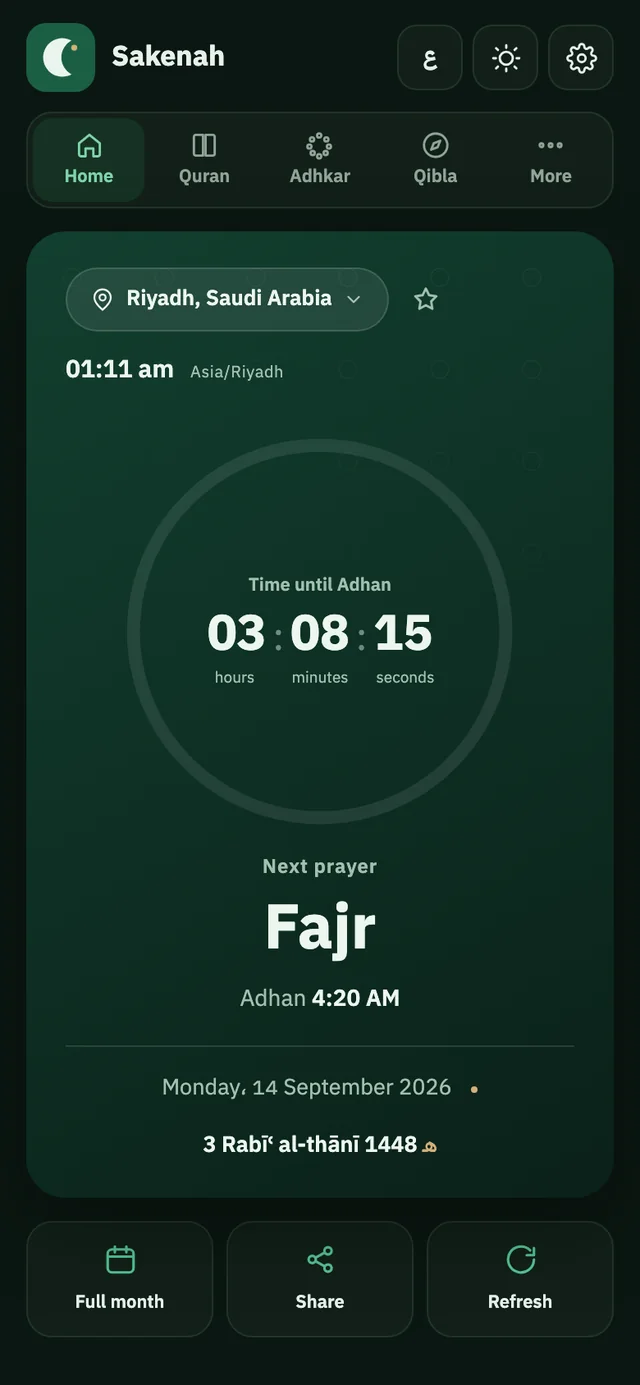
Most of the apps I tried did the job, but they did a lot of other things too. Banners, feeds, features stacked on top of the one thing I needed several times a day: how long until the next prayer? I wanted to open something, see that answer straight away, and close it again. A calm screen, today’s times, and nothing competing for my attention.
So I built that for myself. And once something is on your phone every day, you start noticing what else you wish it did.
The part that became personal
The honest reason Sakenah grew is that I wanted to read the Quran more consistently, and I kept finding small reasons not to.
Some of them were ordinary. I would lose my place, or open a different app and not remember where I had stopped. Others were harder to admit. Sometimes I wasn’t sure how a word should be pronounced, and that uncertainty was enough to make me slow down, and then stop. Listening to a recitation helped, but following along was its own difficulty: the reciter would move on while my eyes were still a line behind.
None of this is unusual. But each one is a little friction, and friction is exactly what decides whether a good intention becomes a habit.
That became the real question behind the product:
How do I remove enough friction that I can pray on time, remember Allah, open the Quran, hear it recited correctly, follow it with my eyes — and come back tomorrow to exactly where I stopped?
وَقَالَ ٱلرَّسُولُ يَـٰرَبِّ إِنَّ قَوْمِى ٱتَّخَذُوا۟ هَـٰذَا ٱلْقُرْءَانَ مَهْجُورًا
And the Messenger has said, “O my Lord, indeed my people have taken this Qur’an as [a thing] abandoned.”
I’m not a scholar, and I don’t want to read more into this verse than I’m qualified to. But I know what it does to me when I read it. It makes me ask whether the Quran is part of my days, or something I return to occasionally — in Ramadan, on a quiet Friday, when something goes wrong.
I don’t want it to be occasional. Building Sakenah was, in part, my attempt to close some of the distance between intending to read and actually reading: to make the first step small enough that there is no reason left to put it off.
And if others find it useful, I hope there is benefit in it beyond me — that Allah accepts it, and makes it a sadaqah jariyah for me, in my life and after my death.
How it grew
From prayer times to a daily companion
Sakenah grew the way tools you actually use tend to grow: one real need at a time, each one tested against my own day before it earned a place.
Salah
“When is the next prayer?”
The original question, and still the first thing on the home screen.
Adhkar
“Morning and evening adhkar, without searching.”
With counts that remember where I was.
Quran
“Open the mushaf where I left it.”
All 114 surahs, bookmarks and Continue Reading.
Recitation
“Hear it correctly, and follow along.”
Ayah by ayah, and word by word where the timing data is reliable.
Khatmah
“Turn reading into a pace I can keep.”
A daily portion across the 604 pages of the mushaf.
Qibla & Friday
“The other questions an ordinary week asks.”
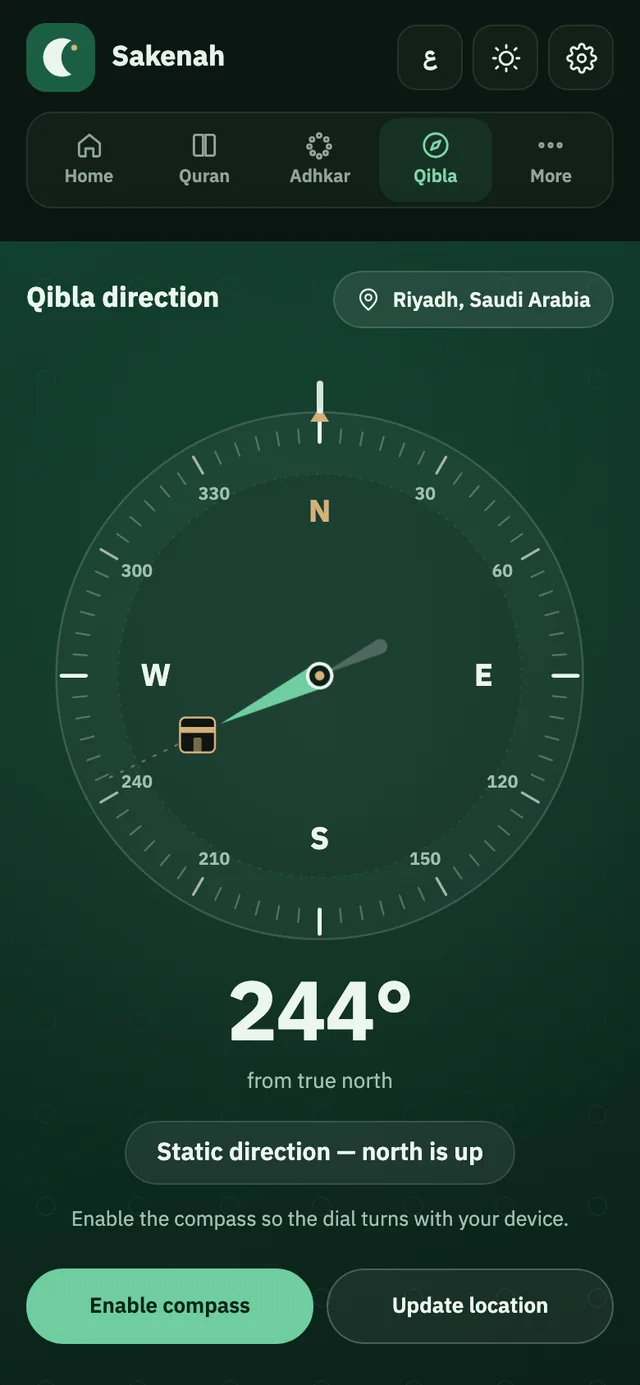
The direction of Makkah, and the Friday khutbah from the Two Holy Mosques.
It still has one job at heart. Everything else is there because it removes a step between intention and action.
The feature I built it for
Hearing the Quran, and following every word
Of everything in Sakenah, this is the part I use most, and the part I was most careful with.
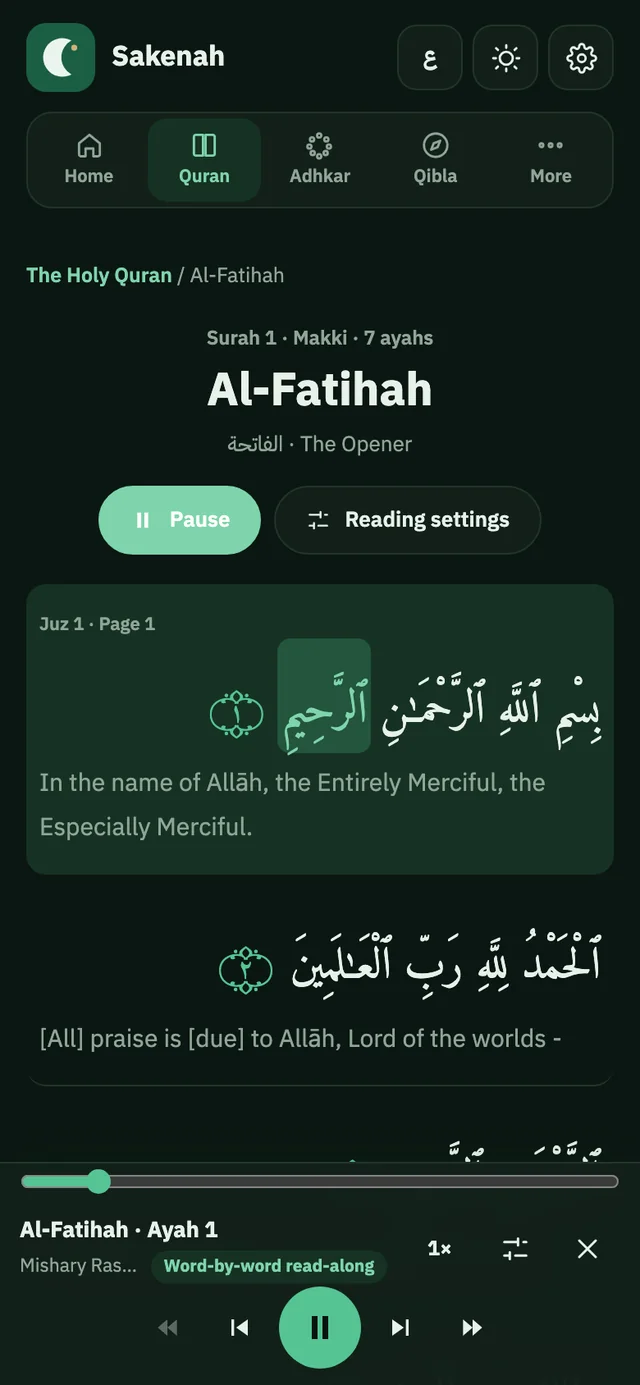
You open a surah, choose a reciter and press Listen. As the recitation plays, the current ayah is highlighted. For reciters where word-level timing data exists, the highlight moves word by word, so your eyes stay exactly where the reciter’s voice is. When you stop, Sakenah remembers the ayah and your position in the audio, and Continue Reading takes you back there the next day.
Around that are the controls you would expect from a proper audio player — previous and next ayah, seeking, playback speed and repeat — along with translations, word meanings and tafsir, for the days you want to understand and not only recite.
A rule I didn’t bend
Word timings are never generated or estimated. If a reciter’s data only supports ayah-level timing, Sakenah follows the ayah and says so. A highlight that lands a word early or late would quietly teach the wrong thing, and I would rather show less than show something wrong.
The same principle applies to the text. The Quran is displayed exactly as the Quran Foundation delivers it, character for character. It is never typed by hand, reconstructed or “cleaned up”, and an automated check verifies all 114 surahs and 6,236 ayahs.
What’s inside
What Sakenah includes today
Version 2.1 is live. This is what it does, described plainly.
Salah
The next prayer, and everything around it
- Next prayer with a live countdown
- Daily prayer times
- Hijri and Gregorian dates
- A monthly prayer calendar
- Location detection, or choose a city yourself
- Saved cities
- Calculation method and Asr madhhab
- 12- or 24-hour time
Quran
A complete reader with recitation
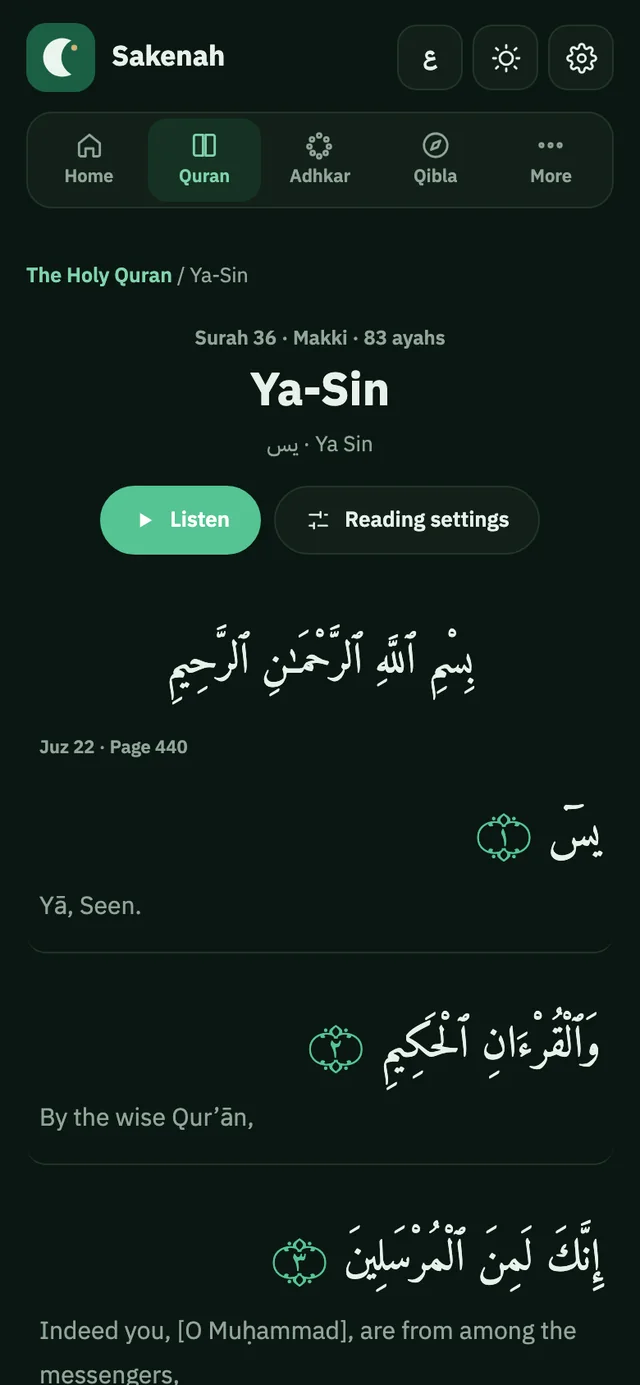
- All 114 surahs
- Deep links to any surah or ayah
- Multiple reciters
- Ayah synchronisation
- Word-by-word read-along where timing exists
- Previous and next ayah, seek, speed, repeat
- Translations and word meanings
- Tafsir
- Bookmarks and Continue Reading
- Khatmah planning with a daily portion
- Reading progress kept on your device
Adhkar
Morning, evening and after prayer
The adhkar as narrated, with counts that stay where you left them through the day.
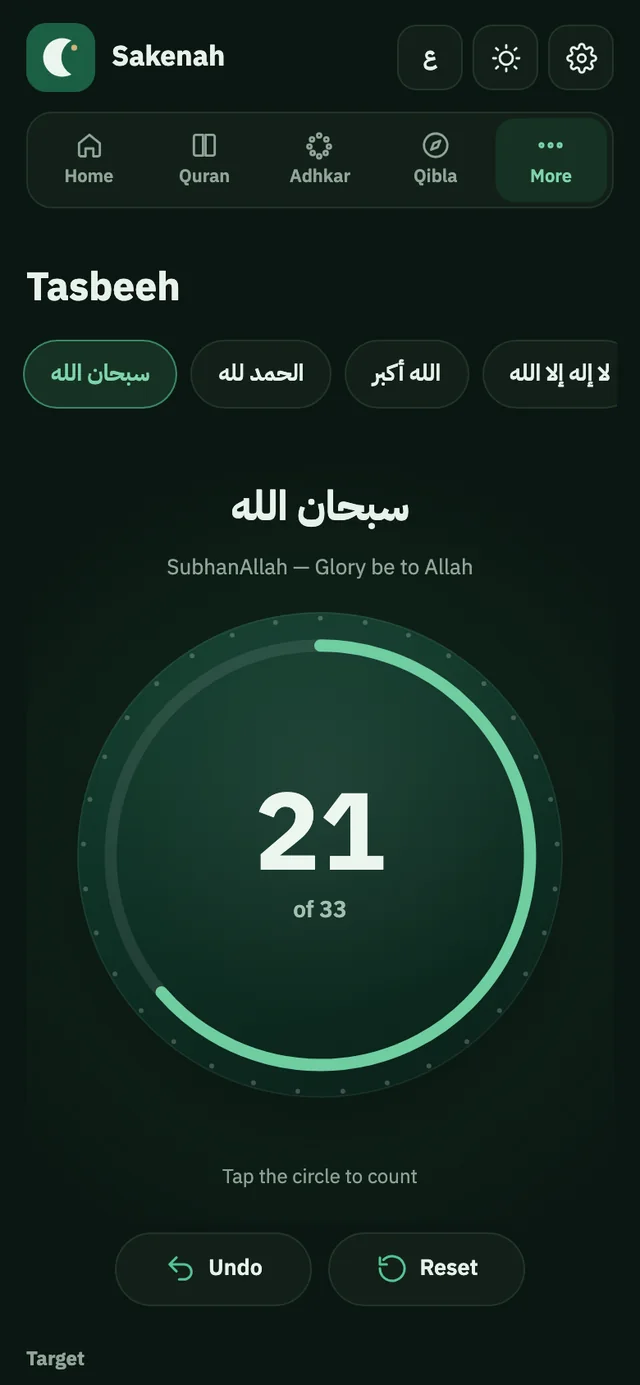
Tasbeeh
A quiet digital tasbeeh
- Presets, or your own dhikr
- Targets of 33, 34, 100 or your own
- Undo and reset
- Optional sound and haptics
- Saved on your device
Qibla
Direction you can trust
- Geographic Qibla bearing from your location
- Distance to Makkah
- A live compass where the device supports it reliably
- Clear permission and sensor states
- A fixed, north-up direction when compass data isn’t reliable
Friday
The khutbah from the Two Holy Mosques
A Friday card with the official streams from Masjid al-Haram and Masjid an-Nabawi. It comes forward around khutbah time.
App
Install it like an app
Installs on Android, with clear Add to Home Screen steps on iPhone and iPad. It opens full-screen, is built to keep working offline, and only updates when you choose to.
- No account required
- Preferences stay on your device
- Arabic-first, fully bilingual
- Light and mobile-first
- No streaks, points or rankings
Decisions
The product decisions behind it
-
01No account
Nothing in Sakenah’s core needs to know who you are. Preferences, bookmarks, Khatmah plans and tasbeeh counts are stored on your device. When you use your location, it is rounded to about a kilometre first, so a precise position is never sent or stored.
-
02No false precision
Prayer times show the city and the calculation method they are based on. The Qibla view treats the geographic bearing as the source of truth and the live compass as a layer on top: if the sensor is missing or unreliable, it says so rather than pointing confidently in the wrong direction.
-
03No invented recitation timing
Word highlighting appears only where the timing data supports it. Reciters without word-level data follow the ayah, and are labelled that way.
-
04Calm over engagement
There are no streaks, totals or rankings. Worship isn’t a leaderboard, and I didn’t want an app that makes you feel behind every time you open it.
-
05A web app you can install
As a PWA, one codebase serves Android, iPhone and desktop, installs without an app store, and uses a service worker so core features keep working offline. A new version waits until you accept it, so nothing changes under you in the middle of a recitation.
-
06Arabic first, not translated
The right-to-left Arabic interface is the original. English is its own edition, with its own direction and wording, rather than a layer of translated labels.
Engineering
Built to be relied on, not just demoed
Sakenah is written in plain JavaScript modules: no framework, no build step and no runtime dependencies. Each part of the app loads only when you open it, which keeps the first screen light on a phone.
- Front end
- Vanilla JavaScript ES modules, clean deep-link routing, views loaded on demand, and complete right-to-left and left-to-right layouts.
- Offline
- A service worker, cached prayer calendars, a bounded cache for Quran data, and an update flow the user approves.
- Time
- Prayer times are resolved in the city’s own time zone, whatever the device’s clock is set to, so “today” is always the right day.
- Data
- A prayer-times API, and a read-only, allowlisted proxy to the Quran Foundation API for the text, translations and recitation timing.
- Server
- A Node service behind Nginx on a VPS, run by systemd and reachable only through Nginx.
- Quality
- Unit and integration tests, browser tests for the features and the recitation, and a full verification of the Quran text.
Before the latest release went live
- Automated tests passing locally
- 183
- Production feature checks
- 59/59
- Quran and recitation checks
- 30/30
- Ayahs verified against the source
- 6,236
Those numbers matter less than the habit behind them. The first time I released version 2.1, production verification caught a real problem: a browser that had used the previous version could load the new page together with an old cached script, and the app stopped. I rolled back straight away, fixed the upgrade path so existing browsers refresh their cached files once, and released again only when every check passed.
That’s the part of the work nobody sees when it goes right. It’s also the part I care about most.
What I learned
Building for your own day is a demanding standard
A real need is a good product manager
Every feature had to survive a simple test: would I open this tomorrow? Plenty of ideas didn’t.
Trust lives in details nobody advertises
A highlighted word that’s slightly late, a compass that points confidently the wrong way, one mark changed in the text. Each is easy to ship and hard to notice, and each is a good reason to stop trusting an app.
Calm is a design decision
Adding is easier than leaving out. Sakenah is quiet on purpose, and keeping it that way takes more discipline than building the next feature.
Live now · Version 2.1
Sakenah is live
You can open Sakenah at sakenah.3dot.tech, add it to your home screen, and use it without signing up for anything.
It will keep changing the same way it started: from using it every day and noticing what gets in the way. If you use it and something doesn’t look right — a time, a label, a word in the recitation — I would genuinely like to hear about it.
My hope for Sakenah is simple: that it helps someone pray on time, remember Allah a little more often, and open the Quran on a day they otherwise wouldn’t have. If it does that for even a few people, it will have been worth building.